 > BOARD > 댓글형
댓글형
In Yeongyang, fireflies light up the night sky
- 작성자 : YANG BO-RA( summerlee@joongang.co.kr )
- 작성일 : 2016-08-28
- 최종수정일 : 2016-08-28
- 조회수 : 494
During a nighttime stroll through the countryside on a summer night, you might be able to see zigzagging lights flickering off in the distance. Fireflies, which could be seen throughout the country a few decades ago, have now become a rare sight seen only far away from the bustling city.
If you are looking to bring back memories of trying to catch fireflies as a kid, head to Yeongyang in North Gyeongsang, known for its well-preserved natural environment. The creatures magically light up the complete darkness of the night sky, a great distance from the cities filled with neon signs.
The fireflies, known as banditbuli in Korean, have many different names throughout the country. In the Jeolla provinces, they are called ggarang. People in the Gyeongsang provinces call them ggarangi. Another widely known name to call fireflies is gaeddongbeolle, which directly translated to dog poop insects. Some people misunderstand the name and think they are dirty creatures living in dog feces, but on the contrary, they can only live in a very clean environment. Many ecological experts consider any area that can be a firefly habitat clean enough for many other creatures to live as well.
Top: Visitors to Yeongyang Firefly Ecological Center inside the Yeongyang County Natural and Ecological Park can take a look at the samples of different types of fireflies. Bottom: A family of four are taking a look at a firefly captured in a container. [IM HYUNG-DONG]
Yeongyang County is one of the most remote locales in Korea, and is known to have a notably dark night thanks to the few artificial lights set up in the community. The town, which rarely sees many visitors, gets busy during the summer from the flocks of people in search of a spectacle of lights. While thousand of stars light up the sky, hundreds of fireflies take care of lighting up the ground.
“Fireflies react strongly to artificial lights,” said Kim Tae-ho, an official with the National Institute of Biological Resources.
“Yeongyang County, with fewer lights out in the fields, provides the perfect habitat for the creatures.”
The place to go is Yeongyang County Natural and Ecological Park, which covers roughly 3.9 million square meters (1.5 square miles). About half the area of this ecological park is designated as a special area for firefly habitats. The zone has been managed by the county office since the area near Jangsupo Stream was given the designation in 2005.
The clean water in Jangsupo Stream is an abundant source of food that fireflies need to survive, including a type of snail that is also only found in cleaner water.
“Thanks to the policy that forbids the spraying of agricultural pesticides in the area, you can see the incredible scene of a few thousands fireflies flying together around the end of August.”
Elsewhere, the decreasing number of creatures like snails that fireflies feed upon contributes to the drop in the number of the glowing bugs.
1. Larvae of neut banditbuli, one of the most common firefly species found in Korea. 2. A fully-grown neut banditbuli are usually seen from early August to early September each year. 3. Left is male neut banditbuli and the right is the female neut banditbuli. The female cannot fly. [IM HYUNG-DONG]
A sight to see
“Around 8 p.m., the sun starts to set and the darkness takes over the sky. After finding the trail, walk towards the firefly zone within the park. It is recommended to turn off any lanterns you might be carrying to find a way in the dark.
““You need to get used to being in the dark to see the fireflies as they are hard to be seen by the naked eye,” said Kim, an official with the National Institute of Biological Resources, adding that even at times when the moonlight is bright, the fireflies are not easy to see.
““You should avoid coming here to see the fireflies when there is a full moon. It is ideal to come when the moon gets thinner.”
“On the night of this reporter’s visit, one green light appeared in the air soon after lanterns were turned off. That light jumped from one tree to another and then disappeared into the forest. A few steps later, about 100 fireflies appeared.
“Official Kim from the National Institute of Biological Resources quickly caught a firefly with a net. It was a neut banditbuli, which is as large as the joint of a finger. It is a firefly species that is commonly found in Korea, along with unmunsan banditbuli and ae banditbuli. Unmunsan banditbuli and ae banditbuli are often seen between May and July, and neut banditbuli are usually seen from August to September. There are about eight species found in Korea, while there are about 200 different species worldwide.
“A firefly has a luminescent organ on its stomach. A substance called luciferin meets with oxygen and makes the creature light up. Male fireflies have two luminescent organs while females have only one.
““Right now the neut banditbuli is mating,” said Kim, adding that the males are flying in the mountains and paddy fields and light themselves up while looking to the same response from the female fireflies.
““The females on the tree respond with their lights, but when there is artificial light, the male and females cannot communicate with their lights. So that’s why we need to keep the place dark.”
“Fireflies spend most of their lives laying low near the bottom of streams or deep inside grass fields. The creatures come out to the open air during the summer for about 15 days to mate. After mating, male fireflies typically die, and females die about two or three days after laying their eggs.
“After trying to catch the fireflies flying all around, turn your head to the ground. Visitors will easily see the insects sparkling in the grass fields. If you take a closer look, you see that they are the glowing larvae of the fireflies.
““The eggs, larvae and flies in a pupal state all light up,” said Kim.
““If these larvae survive the winter, they will be the ones that lit up the skies in the summer next year.”
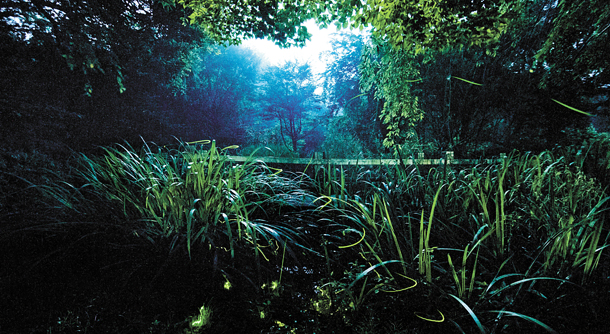
At Yeongyang’s special firefly zone is home to many fireflies. [IM HYUNG-DONG]
BY YANG BO-RA [summerlee@joongang.co.kr]
From Seoul City Hall to Yeongyang County Natural and Ecological Park in Yeongyang County, North Gyeongsang, it takes about four hours and thirty minutes by car. Visitors can try finding fireflies while walking along the trail inside the park. There is also a Firefly Ecological Center within the park where one can see samples of different types of fireflies and other insects found in the area. The center is operated from 10 a.m. to 6 p.m. everyday and it is 2,000 ($1.79) won for adults and 1,000 won for children to get in.
Only one day a year, there is an event called “Finding Fireflies,” when visitors can watch fireflies with a ecological expert and also fly the fireflies to the sky. The event for this year is on today from 10 a.m. to 10 p.m. The event is free. For more information, called (054) 680-5331.
[빛 없어야 더 빛나는 ‘땅위의 별’여름밤 수놓는 반딧불이]
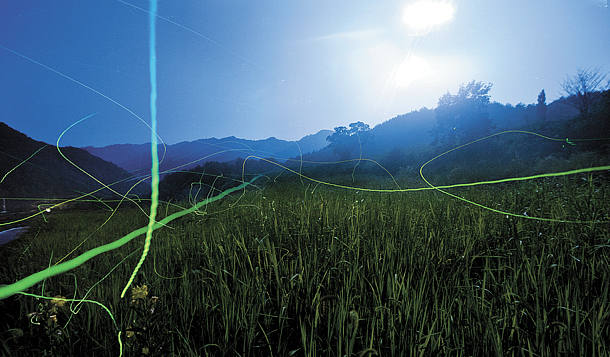
경북 영양의 밤하늘을 밝히는 늦반딧불이 불빛을 카메라로 포착했다. 카메라 셔터 속도를 4초로 두고 한 시간 동안 연속 촬영 한 사진 50장을 이미지 편집 프로그램으로 합성했다. 렌즈 16㎜, 조리개값 F5.0.
.
한여름 밤하늘에서 깜박거리는 불빛을 본 적이 있습니까? 움직이는 불빛을 보고 도깨비를 본 것은 아닐까 놀라지는 않았습니까? 그런 기억을 품고 있다면, 우리는 구면일지 모르겠습니다. 나는 ‘반딧불이’, 빛을 내며 날아다니는 곤충입니다.
나는 이름이 제법 많습니다. 전라도에서는 ‘까랑’, 경상도에서는 ‘까랑이’라고 한다지요. ‘개똥벌레’도 나를 가리키는 이름이지요. ‘개똥벌레’라는 노래 때문인지 개똥에 사는 더러운 벌레라는 오해를 받기도 하지만, 우리 종족은 깨끗한 곳에서만 살 수 있습니다. 생물학자들은 우리를 환경 지표로 삼는다지요. 반딧불이가 산다는 것은 곧 그 지역이 청정하다는 의미랍니다.
전 세계에 퍼진 우리 종족은 2000종이나 됩니다. 한국에는 8종이 사는데, 애반딧불이·운문산반딧불이·늦반딧불이 세 종류가 제일 많습니다. 애반딧불이 애벌레는 다슬기를 먹고, 운문산반딧불이 애벌레와 늦반딧불이 애벌레는 달팽이를 좋아합니다. 다슬기는 2급수 이상 깨끗한 물에만 서식하고, 달팽이는 낙엽 깔린 축축한 흙에서 살지요. 요즘엔 도시는 고사하고 농촌에서도 먹이를 구하기가 힘들어졌습니다. 농약과 화학비료 때문입니다. 애벌레 상태로 겨울을 나는 우리 종족은 여름을 앞두고 어른벌레(성충)로 변신합니다. 배에 형광색 조명(발광기)을 켜고 이르면 5월 말부터 밤하늘을 날아다니지요. 반딧불이의 빛은 구애의 빛입니다. 암수가 불빛을 주고받으며 제 짝을 알아봅니다.
요즘에는 사랑을 나눌 장소도 마땅찮습니다. 가로등에, 네온사인에 번쩍번쩍한 인공 빛이 가득하기 때문이죠. 환한 밤하늘 아래에서 우리는 짝짓기를 할 수 없습니다. 한국은 G20 국가 중에서 사우디아라비아 다음으로 ‘빛 공해(인공조명으로 밤이 낮처럼 밝은 현상)’가 심한 나라이라지요.
사실 개똥벌레라는 이름은 개똥만큼 흔한 벌레라는 뜻이었지요. 그러나 요즘은 ‘금벌레’나 ‘다이아몬드벌레’가 더 어울리는 이름일 것 같습니다. 전북 무주 설천면 삼공리(천연기념물 322호)나 경북 영양 수비면 수하리(영양반딧불이특구) 등 깊은 산골에서만 우리를 볼 수 있으니까요.
이마에 송골송골 땀 맺히던 여름밤, 오두막에 앉아 구경했던 반딧불이를 기억하시는지요. 자연을 아낀다면, 불필요한 조명을 끈다면 우리는 언제고 당신 곁에 찾아가 춤을 출 겁니다. 나는 반짝반짝 빛나는 ‘지상의 별’ 반딧불이입니다.
여름밤이면 반딧불이를 흔히 볼 수 있는 시절이 있었다. 그러나 이제는 아니다. 언제부터인가 반딧불이는 인적 드문 시골에서만 겨우 볼 수 있는 귀한 신분이 되었다. 여름이 다 가기 전에 반딧불이 빛나는 밤을 보고 싶었다. 국내 대표 청정 지역으로 꼽히는 경북 영양으로 향했다. 반딧불이가 빛나는 영양의 밤은 네온사인이 켜진 도시의 밤보다 신비롭고 아름다웠다.
경북 영양은 첩첩산중의 오지다. 이 벽촌으로 ‘밤’을 즐기려는 여행객이 모여든다. 영양의 밤이 도시의 밤처럼 휘황찬란해서가 아니다. 영양은 우리나라에서 밤이 가장 깜깜한 고장이다. 인공 조명의 영향이 적어서다. 그러나 그 어둠 덕분에 영양의 밤은 외려 환해진다. 구름 없는 날이면 수천 개 별이 영양의 밤을 환히 밝히기 때문이다.
영양의 밤을 밝히는 것이 별 말고도 하나 더 있다. ‘지상의 별’ 반딧불이다. 국립생물자원관 김태호(47) 박사는 “반딧불이는 인공조명에 민감하게 반응하는 생물”이라며 “빛 공해가 적은 영양은 반딧불이가 살아가기에 최적의 환경”이라고 설명했다. 전북 무주, 제주 등 전국 곳곳에 반딧불이가 출현하는 곳이 더러 있지만, 영양을 반딧불이 여행지로 낙점한 이유다.
영양군에서도 수비면 수하리에 있는 영양군자연생태공원(390만㎡)이 반딧불이 여행의 최종 목적지다. 이 생태공원 안에 영양군이 관리하는 영양반딧불이특구(193만㎡)가 있다. 영양군은 2005년 1급수가 흐르는 장수포천 주변을 영양반딧불이특구로 지정하고, 반딧불이 서식지로 보호하고 있다.
“장수포천은 멸종위기 1급 동물인 수달이 서식할 정도로 물이 깨끗합니다. 반딧불이가 장수포천에서 다슬기·달팽이 등을 쉽게 잡아먹을 수 있습니다. 동식물 채집과 농약 살포를 일절 금지한 덕분이죠. 8월 하순이 되면 반딧불이 수천 마리가 날아다니는 장관을 볼 수 있습니다.”
영양반딧불이특구에서 만난 영양군청 김강규(55) 사무관의 말에 기대감이 부풀었다. 교과서에서나 봤던 반딧불이를 만날 수 있다는 생각에 얼른 밤이 찾아오길 기다렸다. 오후 8시가 되자 드디어 어둠이 찾아들었다. 김경호(39) 연구원과 함께 영양반딧불이특구에 조성된 산책로를 따라 반딧불이를 찾아 나섰다. 랜턴 불빛에 의지해 발걸음을 옮기는데 김 연구원이 “랜턴을 끄고 어둠에 익숙해지라”고 말했다.
“형광등 밝기가 600lx(럭스)인데 반해 반딧불이 불빛의 밝기는 3lx밖에 안돼요. 인공조명이 있으면 반딧불이 관찰이 힘듭니다. 달빛 아래서도 반딧불이가 보이지 않는 경우가 있어요. 달이 훤한 보름은 피하고 그믐에 맞춰 반딧불이 탐사를 나서는 게 좋습니다.”
서둘러 랜턴을 끄자 사위가 빛 하나 없는 어둠에 잠겼다. 그때였다. 연둣빛 하나가 공중에 나타났다. 반딧불이였다. 작지만 영롱한 빛 하나가 나무를 옮겨 타다 유유히 숲 속으로 사라졌다. 생애 첫 반딧불이와의 조우였다. 반딧불이가 도망 갈까봐 감탄사가 튀어나오려는 입을 황급히 막았다. 몇 걸음을 더 옮기니 한데 모여 반짝거리던 반딧불이 100여 마리가 보였다. 하늘의 별이 땅으로 내려온 듯했다.
김 연구원이 표충망을 휘둘러 반딧불이 한 마리를 잡아 보여줬다. 손가락 마디만한 크기의 ‘늦반딧불이’였다. 늦반딧불이는 ‘운문산반딧불이’ ‘애반딧불이’와 함께 우리나라에서 가장 많이 볼 수 있는 반딧불이 종이다. 운문산반딧불이와 애반딧불이는 5월 말에서 7월 말 사이에 모습을 드러내고, 늦반딧불이는 8월부터 9월까지 출현한다.
반딧불이는 배 부분에 밝게 빛나는 발광기를 달고 있는데, 발광기에 있는 루시페린이라는 물질이 산소와 만나면서 빛을 낸다. 수컷은 발광기 두 개, 암컷은 한 개를 달고 있다. 김 연구원의 설명을 듣고 늦반딧불이의 배 부분을 보니 발광기 두 개가 빛나고 있었다. 수컷이었다.
“지금 늦반딧불이 짝짓기가 한창이에요. 수컷이 산과 들을 헤집고 다니면서 깜박거리면 풀잎이나 나무에 붙어 있는 암컷도 불빛을 밝히며 응답합니다. 인공조명이 있으면 반딧불이는 빛 신호를 주고받을 수 없어요. 우리가 어둠을 지켜야 하는 이유가 여기에 있습니다.”
반딧불이는 생의 대부분을 하천 바닥이나 풀숲 깊숙한 곳에 몸을 숨긴 채 살아간다. 그런 반딧불이가 일생에 한 번뿐인 외출을 감행한다. 짝을 찾기 위해 여름밤을 날아다닐 때다. 반딧불이가 짝을 찾을 수 있는 기간은 기껏해야 보름 남짓이다. 수컷은 짝짓기가 끝나면 죽고, 암컷은 짝짓기 2~3일 뒤 알을 낳고 죽는다. 평생에 한 번뿐인 사랑을 위해 반딧불이는 그렇게 온몸을 밝히는 것이다.
“이제 하늘에서 눈을 떼고 땅을 보세요.”
하늘을 날아다니는 반딧불이를 찾기 위해 힘껏 젖혔던 고개를 얼른 숙였다. 수풀 속에서 반짝거리는 빛이 눈에 들어왔다. 주변을 유심히 살펴보니 수십 개 빛이 수풀 여기저기에 달려있었다. 조심스럽게 빛을 만져봤다. 빛의 주인공은 손가락 두 마디 정도 크기의 늦반딧불이 애벌레였다.
“반딧불이는 알도, 애벌레도, 번데기도 빛이 납니다. 어른벌레처럼 날아다니지 못해도 생명의 빛을 품고 있죠. 이 에벌레가 겨울을 이겨내면 내년 여름에는 환한 빛을 내며 날아오를 겁니다.”
늦반딧불이 애벌레 빛은 어른벌레보다 밝기가 덜했다. 애벌래 빛은 꺼질 듯하지만 결코 꺼지지 않았다. 내년에도, 내후년에도 반딧불이의 빛이 이어지길 바랐다.
여행정보=서울시청에서 경북 영양 영양군자연생태공원까지는 자동차로 4시간 30분 걸린다. 생태공원 산책로를 따라 걸으면서 반딧불이를 찾아볼 수 있다. 공원 안에 영양반딧불이생태학교도 있다. 반딧불이·사슴벌레 등 곤충 표본을 볼 수 있다. 운영시간 오전 10시∼오후 6시. 입장료 어른 2000원 어린이 1000원. 1년에 딱 하루 ‘반딧불이 탐사행사’가 개최된다. 올해는 27일 오전 10시∼오후 10시 진행된다. 생태해설사와 함께 반딧불이를 관찰하고 반딧불이 날리기 등을 체험할 수 있다. 무료. 054-680-5331.
If you are looking to bring back memories of trying to catch fireflies as a kid, head to Yeongyang in North Gyeongsang, known for its well-preserved natural environment. The creatures magically light up the complete darkness of the night sky, a great distance from the cities filled with neon signs.
The fireflies, known as banditbuli in Korean, have many different names throughout the country. In the Jeolla provinces, they are called ggarang. People in the Gyeongsang provinces call them ggarangi. Another widely known name to call fireflies is gaeddongbeolle, which directly translated to dog poop insects. Some people misunderstand the name and think they are dirty creatures living in dog feces, but on the contrary, they can only live in a very clean environment. Many ecological experts consider any area that can be a firefly habitat clean enough for many other creatures to live as well.
Top: Visitors to Yeongyang Firefly Ecological Center inside the Yeongyang County Natural and Ecological Park can take a look at the samples of different types of fireflies. Bottom: A family of four are taking a look at a firefly captured in a container. [IM HYUNG-DONG]
Yeongyang County is one of the most remote locales in Korea, and is known to have a notably dark night thanks to the few artificial lights set up in the community. The town, which rarely sees many visitors, gets busy during the summer from the flocks of people in search of a spectacle of lights. While thousand of stars light up the sky, hundreds of fireflies take care of lighting up the ground.
“Fireflies react strongly to artificial lights,” said Kim Tae-ho, an official with the National Institute of Biological Resources.
“Yeongyang County, with fewer lights out in the fields, provides the perfect habitat for the creatures.”
The place to go is Yeongyang County Natural and Ecological Park, which covers roughly 3.9 million square meters (1.5 square miles). About half the area of this ecological park is designated as a special area for firefly habitats. The zone has been managed by the county office since the area near Jangsupo Stream was given the designation in 2005.
The clean water in Jangsupo Stream is an abundant source of food that fireflies need to survive, including a type of snail that is also only found in cleaner water.
“Thanks to the policy that forbids the spraying of agricultural pesticides in the area, you can see the incredible scene of a few thousands fireflies flying together around the end of August.”
Elsewhere, the decreasing number of creatures like snails that fireflies feed upon contributes to the drop in the number of the glowing bugs.
1. Larvae of neut banditbuli, one of the most common firefly species found in Korea. 2. A fully-grown neut banditbuli are usually seen from early August to early September each year. 3. Left is male neut banditbuli and the right is the female neut banditbuli. The female cannot fly. [IM HYUNG-DONG]
A sight to see
“Around 8 p.m., the sun starts to set and the darkness takes over the sky. After finding the trail, walk towards the firefly zone within the park. It is recommended to turn off any lanterns you might be carrying to find a way in the dark.
““You need to get used to being in the dark to see the fireflies as they are hard to be seen by the naked eye,” said Kim, an official with the National Institute of Biological Resources, adding that even at times when the moonlight is bright, the fireflies are not easy to see.
““You should avoid coming here to see the fireflies when there is a full moon. It is ideal to come when the moon gets thinner.”
“On the night of this reporter’s visit, one green light appeared in the air soon after lanterns were turned off. That light jumped from one tree to another and then disappeared into the forest. A few steps later, about 100 fireflies appeared.
“Official Kim from the National Institute of Biological Resources quickly caught a firefly with a net. It was a neut banditbuli, which is as large as the joint of a finger. It is a firefly species that is commonly found in Korea, along with unmunsan banditbuli and ae banditbuli. Unmunsan banditbuli and ae banditbuli are often seen between May and July, and neut banditbuli are usually seen from August to September. There are about eight species found in Korea, while there are about 200 different species worldwide.
“A firefly has a luminescent organ on its stomach. A substance called luciferin meets with oxygen and makes the creature light up. Male fireflies have two luminescent organs while females have only one.
““Right now the neut banditbuli is mating,” said Kim, adding that the males are flying in the mountains and paddy fields and light themselves up while looking to the same response from the female fireflies.
““The females on the tree respond with their lights, but when there is artificial light, the male and females cannot communicate with their lights. So that’s why we need to keep the place dark.”
“Fireflies spend most of their lives laying low near the bottom of streams or deep inside grass fields. The creatures come out to the open air during the summer for about 15 days to mate. After mating, male fireflies typically die, and females die about two or three days after laying their eggs.
“After trying to catch the fireflies flying all around, turn your head to the ground. Visitors will easily see the insects sparkling in the grass fields. If you take a closer look, you see that they are the glowing larvae of the fireflies.
““The eggs, larvae and flies in a pupal state all light up,” said Kim.
““If these larvae survive the winter, they will be the ones that lit up the skies in the summer next year.”
At Yeongyang’s special firefly zone is home to many fireflies. [IM HYUNG-DONG]
BY YANG BO-RA [summerlee@joongang.co.kr]
From Seoul City Hall to Yeongyang County Natural and Ecological Park in Yeongyang County, North Gyeongsang, it takes about four hours and thirty minutes by car. Visitors can try finding fireflies while walking along the trail inside the park. There is also a Firefly Ecological Center within the park where one can see samples of different types of fireflies and other insects found in the area. The center is operated from 10 a.m. to 6 p.m. everyday and it is 2,000 ($1.79) won for adults and 1,000 won for children to get in.
Only one day a year, there is an event called “Finding Fireflies,” when visitors can watch fireflies with a ecological expert and also fly the fireflies to the sky. The event for this year is on today from 10 a.m. to 10 p.m. The event is free. For more information, called (054) 680-5331.
[빛 없어야 더 빛나는 ‘땅위의 별’여름밤 수놓는 반딧불이]
경북 영양의 밤하늘을 밝히는 늦반딧불이 불빛을 카메라로 포착했다. 카메라 셔터 속도를 4초로 두고 한 시간 동안 연속 촬영 한 사진 50장을 이미지 편집 프로그램으로 합성했다. 렌즈 16㎜, 조리개값 F5.0.
.
한여름 밤하늘에서 깜박거리는 불빛을 본 적이 있습니까? 움직이는 불빛을 보고 도깨비를 본 것은 아닐까 놀라지는 않았습니까? 그런 기억을 품고 있다면, 우리는 구면일지 모르겠습니다. 나는 ‘반딧불이’, 빛을 내며 날아다니는 곤충입니다.
나는 이름이 제법 많습니다. 전라도에서는 ‘까랑’, 경상도에서는 ‘까랑이’라고 한다지요. ‘개똥벌레’도 나를 가리키는 이름이지요. ‘개똥벌레’라는 노래 때문인지 개똥에 사는 더러운 벌레라는 오해를 받기도 하지만, 우리 종족은 깨끗한 곳에서만 살 수 있습니다. 생물학자들은 우리를 환경 지표로 삼는다지요. 반딧불이가 산다는 것은 곧 그 지역이 청정하다는 의미랍니다.
전 세계에 퍼진 우리 종족은 2000종이나 됩니다. 한국에는 8종이 사는데, 애반딧불이·운문산반딧불이·늦반딧불이 세 종류가 제일 많습니다. 애반딧불이 애벌레는 다슬기를 먹고, 운문산반딧불이 애벌레와 늦반딧불이 애벌레는 달팽이를 좋아합니다. 다슬기는 2급수 이상 깨끗한 물에만 서식하고, 달팽이는 낙엽 깔린 축축한 흙에서 살지요. 요즘엔 도시는 고사하고 농촌에서도 먹이를 구하기가 힘들어졌습니다. 농약과 화학비료 때문입니다. 애벌레 상태로 겨울을 나는 우리 종족은 여름을 앞두고 어른벌레(성충)로 변신합니다. 배에 형광색 조명(발광기)을 켜고 이르면 5월 말부터 밤하늘을 날아다니지요. 반딧불이의 빛은 구애의 빛입니다. 암수가 불빛을 주고받으며 제 짝을 알아봅니다.
요즘에는 사랑을 나눌 장소도 마땅찮습니다. 가로등에, 네온사인에 번쩍번쩍한 인공 빛이 가득하기 때문이죠. 환한 밤하늘 아래에서 우리는 짝짓기를 할 수 없습니다. 한국은 G20 국가 중에서 사우디아라비아 다음으로 ‘빛 공해(인공조명으로 밤이 낮처럼 밝은 현상)’가 심한 나라이라지요.
사실 개똥벌레라는 이름은 개똥만큼 흔한 벌레라는 뜻이었지요. 그러나 요즘은 ‘금벌레’나 ‘다이아몬드벌레’가 더 어울리는 이름일 것 같습니다. 전북 무주 설천면 삼공리(천연기념물 322호)나 경북 영양 수비면 수하리(영양반딧불이특구) 등 깊은 산골에서만 우리를 볼 수 있으니까요.
이마에 송골송골 땀 맺히던 여름밤, 오두막에 앉아 구경했던 반딧불이를 기억하시는지요. 자연을 아낀다면, 불필요한 조명을 끈다면 우리는 언제고 당신 곁에 찾아가 춤을 출 겁니다. 나는 반짝반짝 빛나는 ‘지상의 별’ 반딧불이입니다.
여름밤이면 반딧불이를 흔히 볼 수 있는 시절이 있었다. 그러나 이제는 아니다. 언제부터인가 반딧불이는 인적 드문 시골에서만 겨우 볼 수 있는 귀한 신분이 되었다. 여름이 다 가기 전에 반딧불이 빛나는 밤을 보고 싶었다. 국내 대표 청정 지역으로 꼽히는 경북 영양으로 향했다. 반딧불이가 빛나는 영양의 밤은 네온사인이 켜진 도시의 밤보다 신비롭고 아름다웠다.
경북 영양은 첩첩산중의 오지다. 이 벽촌으로 ‘밤’을 즐기려는 여행객이 모여든다. 영양의 밤이 도시의 밤처럼 휘황찬란해서가 아니다. 영양은 우리나라에서 밤이 가장 깜깜한 고장이다. 인공 조명의 영향이 적어서다. 그러나 그 어둠 덕분에 영양의 밤은 외려 환해진다. 구름 없는 날이면 수천 개 별이 영양의 밤을 환히 밝히기 때문이다.
영양의 밤을 밝히는 것이 별 말고도 하나 더 있다. ‘지상의 별’ 반딧불이다. 국립생물자원관 김태호(47) 박사는 “반딧불이는 인공조명에 민감하게 반응하는 생물”이라며 “빛 공해가 적은 영양은 반딧불이가 살아가기에 최적의 환경”이라고 설명했다. 전북 무주, 제주 등 전국 곳곳에 반딧불이가 출현하는 곳이 더러 있지만, 영양을 반딧불이 여행지로 낙점한 이유다.
영양군에서도 수비면 수하리에 있는 영양군자연생태공원(390만㎡)이 반딧불이 여행의 최종 목적지다. 이 생태공원 안에 영양군이 관리하는 영양반딧불이특구(193만㎡)가 있다. 영양군은 2005년 1급수가 흐르는 장수포천 주변을 영양반딧불이특구로 지정하고, 반딧불이 서식지로 보호하고 있다.
“장수포천은 멸종위기 1급 동물인 수달이 서식할 정도로 물이 깨끗합니다. 반딧불이가 장수포천에서 다슬기·달팽이 등을 쉽게 잡아먹을 수 있습니다. 동식물 채집과 농약 살포를 일절 금지한 덕분이죠. 8월 하순이 되면 반딧불이 수천 마리가 날아다니는 장관을 볼 수 있습니다.”
영양반딧불이특구에서 만난 영양군청 김강규(55) 사무관의 말에 기대감이 부풀었다. 교과서에서나 봤던 반딧불이를 만날 수 있다는 생각에 얼른 밤이 찾아오길 기다렸다. 오후 8시가 되자 드디어 어둠이 찾아들었다. 김경호(39) 연구원과 함께 영양반딧불이특구에 조성된 산책로를 따라 반딧불이를 찾아 나섰다. 랜턴 불빛에 의지해 발걸음을 옮기는데 김 연구원이 “랜턴을 끄고 어둠에 익숙해지라”고 말했다.
“형광등 밝기가 600lx(럭스)인데 반해 반딧불이 불빛의 밝기는 3lx밖에 안돼요. 인공조명이 있으면 반딧불이 관찰이 힘듭니다. 달빛 아래서도 반딧불이가 보이지 않는 경우가 있어요. 달이 훤한 보름은 피하고 그믐에 맞춰 반딧불이 탐사를 나서는 게 좋습니다.”
서둘러 랜턴을 끄자 사위가 빛 하나 없는 어둠에 잠겼다. 그때였다. 연둣빛 하나가 공중에 나타났다. 반딧불이였다. 작지만 영롱한 빛 하나가 나무를 옮겨 타다 유유히 숲 속으로 사라졌다. 생애 첫 반딧불이와의 조우였다. 반딧불이가 도망 갈까봐 감탄사가 튀어나오려는 입을 황급히 막았다. 몇 걸음을 더 옮기니 한데 모여 반짝거리던 반딧불이 100여 마리가 보였다. 하늘의 별이 땅으로 내려온 듯했다.
김 연구원이 표충망을 휘둘러 반딧불이 한 마리를 잡아 보여줬다. 손가락 마디만한 크기의 ‘늦반딧불이’였다. 늦반딧불이는 ‘운문산반딧불이’ ‘애반딧불이’와 함께 우리나라에서 가장 많이 볼 수 있는 반딧불이 종이다. 운문산반딧불이와 애반딧불이는 5월 말에서 7월 말 사이에 모습을 드러내고, 늦반딧불이는 8월부터 9월까지 출현한다.
반딧불이는 배 부분에 밝게 빛나는 발광기를 달고 있는데, 발광기에 있는 루시페린이라는 물질이 산소와 만나면서 빛을 낸다. 수컷은 발광기 두 개, 암컷은 한 개를 달고 있다. 김 연구원의 설명을 듣고 늦반딧불이의 배 부분을 보니 발광기 두 개가 빛나고 있었다. 수컷이었다.
“지금 늦반딧불이 짝짓기가 한창이에요. 수컷이 산과 들을 헤집고 다니면서 깜박거리면 풀잎이나 나무에 붙어 있는 암컷도 불빛을 밝히며 응답합니다. 인공조명이 있으면 반딧불이는 빛 신호를 주고받을 수 없어요. 우리가 어둠을 지켜야 하는 이유가 여기에 있습니다.”
반딧불이는 생의 대부분을 하천 바닥이나 풀숲 깊숙한 곳에 몸을 숨긴 채 살아간다. 그런 반딧불이가 일생에 한 번뿐인 외출을 감행한다. 짝을 찾기 위해 여름밤을 날아다닐 때다. 반딧불이가 짝을 찾을 수 있는 기간은 기껏해야 보름 남짓이다. 수컷은 짝짓기가 끝나면 죽고, 암컷은 짝짓기 2~3일 뒤 알을 낳고 죽는다. 평생에 한 번뿐인 사랑을 위해 반딧불이는 그렇게 온몸을 밝히는 것이다.
“이제 하늘에서 눈을 떼고 땅을 보세요.”
하늘을 날아다니는 반딧불이를 찾기 위해 힘껏 젖혔던 고개를 얼른 숙였다. 수풀 속에서 반짝거리는 빛이 눈에 들어왔다. 주변을 유심히 살펴보니 수십 개 빛이 수풀 여기저기에 달려있었다. 조심스럽게 빛을 만져봤다. 빛의 주인공은 손가락 두 마디 정도 크기의 늦반딧불이 애벌레였다.
“반딧불이는 알도, 애벌레도, 번데기도 빛이 납니다. 어른벌레처럼 날아다니지 못해도 생명의 빛을 품고 있죠. 이 에벌레가 겨울을 이겨내면 내년 여름에는 환한 빛을 내며 날아오를 겁니다.”
늦반딧불이 애벌레 빛은 어른벌레보다 밝기가 덜했다. 애벌래 빛은 꺼질 듯하지만 결코 꺼지지 않았다. 내년에도, 내후년에도 반딧불이의 빛이 이어지길 바랐다.
여행정보=서울시청에서 경북 영양 영양군자연생태공원까지는 자동차로 4시간 30분 걸린다. 생태공원 산책로를 따라 걸으면서 반딧불이를 찾아볼 수 있다. 공원 안에 영양반딧불이생태학교도 있다. 반딧불이·사슴벌레 등 곤충 표본을 볼 수 있다. 운영시간 오전 10시∼오후 6시. 입장료 어른 2000원 어린이 1000원. 1년에 딱 하루 ‘반딧불이 탐사행사’가 개최된다. 올해는 27일 오전 10시∼오후 10시 진행된다. 생태해설사와 함께 반딧불이를 관찰하고 반딧불이 날리기 등을 체험할 수 있다. 무료. 054-680-5331.
총게시물: 8 페이지: 1 / 1
| 번호 | 제목 | 작성일 | 작성자 | 조회수 |
|---|---|---|---|---|
| 8 |
The future of home and interior design has arrived in Paris
작성일: 2016-10-07
작성자: LEE SUN-MIN
조회수: 716
|
2016-10-07 | LEE SUN-MIN | 716 |
| 7 |
Deep in the waters around Korea, treasure troves await 2
2
작성일: 2016-10-06
작성자: 최고관리자
조회수: 751
|
2016-10-06 | 최고관리자 | 751 |
| 6 |
Geoje Island offers easy options to get away
2
작성일: 2016-08-28
작성자: LEE SUN-MIN
조회수: 660
|
2016-08-28 | LEE SUN-MIN | 660 |
| 5 |
In Yeongyang, fireflies light up the night sky
작성일: 2016-08-28
작성자: YANG BO-RA
조회수: 494
|
2016-08-28 | YANG BO-RA | 494 |
| 4 |
Suede, Weezer come to Korea for Pentaport
작성일: 2016-07-28
작성자: YIM SEUNG-HYE
조회수: 572
|
2016-07-28 | YIM SEUNG-HYE | 572 |
| 3 |
Temporary exhibit turns ship to symbol
작성일: 2016-07-24
작성자: YIM SEUNG-HYE
조회수: 438
|
2016-07-24 | YIM SEUNG-HYE | 438 |
| 2 |
Korean dreams float on River Thames
작성일: 2016-07-24
작성자: LEE SUN-MIN
조회수: 207
|
2016-07-24 | LEE SUN-MIN | 207 |
| 1 |
Cheaper flights expand possibilities for day trips
작성일: 2016-07-24
작성자: SON MIN-HO, LEE SEOK-HEE
조회수: 214
|
2016-07-24 | SON MIN-HO, LEE SEOK-HEE | 214 |
1