 > BOARD > 답변형
답변형
Joan Miro’s first Korean retrospective is a joy
- 작성자 : MOON SO-YOUNG( symoon@joongang.co.kr )
- 작성일 : 2016-07-20
- 최종수정일 : 2016-07-21
- 조회수 : 267
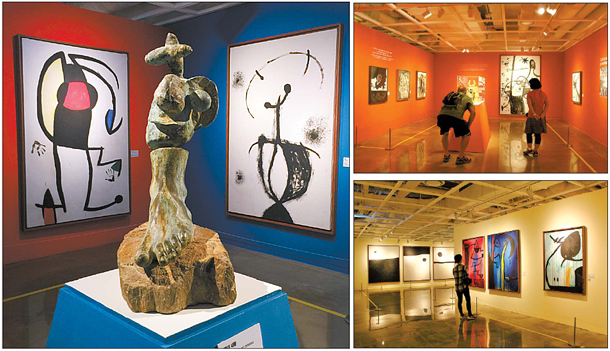
In Seoul, summer is the season for family-friendly, big-scale exhibitions that mainly feature the works of famous Western modern art masters or artifacts loaned by renowned foreign museums.
This summer is no exception, but art lovers should pay particular attention to “Joan Miro in Mallorca: A Wild Spirit,” now running at the Sejong Center in the heart of Seoul.
The exhibition is exceptional in both scale - 264 pieces of the Spanish master’s paintings, sculptures and drawings - and quality.
It is the first-ever retrospective of Miro (1893-1983) in Korea, according to the organizers.
The exhibits include many large-size paintings, most of which feature bold, powerful lines - seemingly dashed off with a few strokes - paired with fields of strong primary colors and white spaces.
In some, these combine to make pure abstract forms. In others, they create unique simplifications of animals and humans full of primitive energy and humor.
In the paintings, nods to primitive art, Western modern abstract art and East Asian calligraphy are all evident. It seems almost curious, then, that Miro’s art is often categorized as Surrealist in textbooks. His almost-abstract paintings full of vigor and cheerfulness are quite different from representative Surrealist works by Salvador Dali and Max Ernst, which are figurative and imbued with an ominous and lethargic air.
“Miro was inspired by diverse art - not only European Surrealism but also American Abstract Expressionism, primitive art and East Asian calligraphy,” Francisco Copado, director of the Pilar and Joan Miro Foundation, said at the Sejong Center in a press meeting late last month.
“He didn’t want his works to be categorized as any of these [movements],” he continued. “He created his own new art based on inspirations [from] all of [them].”
The exhibits are part of the collection of the foundation based in the scenic Spanish island of Majorca, where the artist spent the last three decades of his life and created many works.
Miro’s mother and wife were also from the island, according to Pilar Baos, coordinator of exhibitions at the foundation and curator of the Seoul exhibition.
“Miro’s Majorca period (1956-81) is the most vital and artistic stage, the least known and the most innovative of his career,” Baos said.
The exhibition is divided into five sections.
The first section features Miro’s paintings and sculptures strongly associated with primitive and folk art.
The works in the second section are all paintings containing hieroglyphic-esque symbols between images and text, and they draw from American Abstract Expressionism and East Asian calligraphy.
The third section focuses on Miro’s inspiration from the nature of Majorca. It’s a re-creation of his Sert studio in the island, including his real painting tools and other artifacts as well as some of unfinished pieces.
The fourth section features works that illustrate the artist’s exploration into color and form.
In the fifth section, paintings and sculptures show the artist’s unique way of simplifying natural motifs including celestial bodies, animals and humans.
Meanwhile, the representatives of the foundation said Miro had strong links to Korea through his friendship with musician Ahn Eak-tai, who composed Korea’s national anthem.
After conducting many European orchestras, Ahn settled in Majorca directly after World War II. According to Joan Punyet Miro, historian and the artists’ grandson, the artist’s house was only 100 meters (328 feet) from Ahn’s own.
This summer is no exception, but art lovers should pay particular attention to “Joan Miro in Mallorca: A Wild Spirit,” now running at the Sejong Center in the heart of Seoul.
The exhibition is exceptional in both scale - 264 pieces of the Spanish master’s paintings, sculptures and drawings - and quality.
It is the first-ever retrospective of Miro (1893-1983) in Korea, according to the organizers.
The exhibits include many large-size paintings, most of which feature bold, powerful lines - seemingly dashed off with a few strokes - paired with fields of strong primary colors and white spaces.
In some, these combine to make pure abstract forms. In others, they create unique simplifications of animals and humans full of primitive energy and humor.
In the paintings, nods to primitive art, Western modern abstract art and East Asian calligraphy are all evident. It seems almost curious, then, that Miro’s art is often categorized as Surrealist in textbooks. His almost-abstract paintings full of vigor and cheerfulness are quite different from representative Surrealist works by Salvador Dali and Max Ernst, which are figurative and imbued with an ominous and lethargic air.
“Miro was inspired by diverse art - not only European Surrealism but also American Abstract Expressionism, primitive art and East Asian calligraphy,” Francisco Copado, director of the Pilar and Joan Miro Foundation, said at the Sejong Center in a press meeting late last month.
“He didn’t want his works to be categorized as any of these [movements],” he continued. “He created his own new art based on inspirations [from] all of [them].”
The exhibits are part of the collection of the foundation based in the scenic Spanish island of Majorca, where the artist spent the last three decades of his life and created many works.
Miro’s mother and wife were also from the island, according to Pilar Baos, coordinator of exhibitions at the foundation and curator of the Seoul exhibition.
“Miro’s Majorca period (1956-81) is the most vital and artistic stage, the least known and the most innovative of his career,” Baos said.
The exhibition is divided into five sections.
The first section features Miro’s paintings and sculptures strongly associated with primitive and folk art.
The works in the second section are all paintings containing hieroglyphic-esque symbols between images and text, and they draw from American Abstract Expressionism and East Asian calligraphy.
The third section focuses on Miro’s inspiration from the nature of Majorca. It’s a re-creation of his Sert studio in the island, including his real painting tools and other artifacts as well as some of unfinished pieces.
The fourth section features works that illustrate the artist’s exploration into color and form.
In the fifth section, paintings and sculptures show the artist’s unique way of simplifying natural motifs including celestial bodies, animals and humans.
Meanwhile, the representatives of the foundation said Miro had strong links to Korea through his friendship with musician Ahn Eak-tai, who composed Korea’s national anthem.
After conducting many European orchestras, Ahn settled in Majorca directly after World War II. According to Joan Punyet Miro, historian and the artists’ grandson, the artist’s house was only 100 meters (328 feet) from Ahn’s own.
총게시물: 15 페이지: 2 / 2
| 번호 | 제목 | 작성일 | 작성자 | 조회수 |
|---|---|---|---|---|
| 공지 |
Ten thousand grand views of Mt. Seorak
작성일: 2016-10-06
작성자: PARK JIN-HO
조회수: 4615
|
2016-10-06 | PARK JIN-HO | 4615 |
| 공지 |
Flower art displayed in Gyeonggi
작성일: 2016-07-22
작성자: KIM HYANG-MIN
조회수: 2398
|
2016-07-22 | KIM HYANG-MIN | 2398 |
| 공지 |
O Yoon show marks 30th anniversary of his death
작성일: 2016-07-21
작성자: JEONG JAE-SOOK, KIM HYANG-MIN
조회수: 480
|
2016-07-21 | JEONG JAE-SOOK, KIM HYANG-MIN | 480 |
| 5 |
 Chagall, Dali and Buffet on display at Hangaram Chagall, Dali and Buffet on display at Hangaram
작성일: 2016-07-21
작성자: KIM HYANG-MIN
조회수: 118
|
2016-07-21 | KIM HYANG-MIN | 118 |
| 4 |
Reuters shows the power of images
작성일: 2016-07-21
작성자: KIM HYE-JUN
조회수: 100
|
2016-07-21 | KIM HYE-JUN | 100 |
| 3 |
Traditional carpenter focuses on future
작성일: 2016-07-21
작성자: PARK SANG-MOON
조회수: 146
|
2016-07-21 | PARK SANG-MOON | 146 |
| 2 |
Joan Miro’s first Korean retrospective is a joy
작성일: 2016-07-20
작성자: MOON SO-YOUNG
조회수: 267
|
2016-07-20 | MOON SO-YOUNG | 267 |
| 1 |
Sculpture fair kicks off at COEX
작성일: 2016-07-21
작성자: MOON SO-YOUNG
조회수: 105
|
2016-07-21 | MOON SO-YOUNG | 105 |