 > BOARD > 답변형
답변형
Exhibition defies conventions of Korean painting
- 작성자 : MOON SO-YOUNG( symoon@joongang.co.kr )
- 작성일 : 2016-07-22
- 최종수정일 : 2016-07-27
- 조회수 : 479
When people think of old Korean paintings, they typically recall landscapes done in black ink, depictions of the daily lives of commoners or images of the Buddha.
In other words, they’d be stunned by the 18th- and 19th-century Korean paintings now on display at the Seoul Calligraphy Art Museum in southern Seoul.
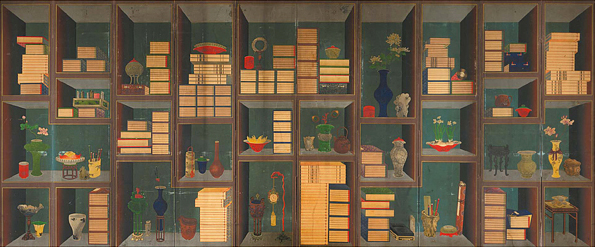
There are the chaekgado, or still-life paintings of bookshelves, that are reminiscent of old European art - particularly trompe l’oeil paintings - due to their use of perspective uncommon in East Asian paintings.
Then, there are the munjado, or letter paintings, which show combinations of images and text so modern-looking that a viewer would be forgiven for thinking they’d been created recently.
Both are part of the exhibition titled “Minhwa and Court Paintings of the Joseon Dynasty: Munja-do and Chaekgeori,” which runs through Aug. 28 at Seoul Calligraphy Art Museum, located in the Seoul Arts Center in southern Seoul.
Chaekgeori is a broader term that refers to the still lifes painted in the 18th and 19th centuries of books, stationery and other curiosities in splendid color. Chaekgado, or depictions of books and objects arranged on shelves, is one category of chaekgeori.
According to Lee Dong-kook, head of the Seoul Arts Center’s Calligraphy Art Department, chaekgeori paintings show not only a rare case of European influence on Korean art before the 20th century, but also the admiration for learning and knowledge that has long been Korean tradition.
“It is the exquisite fusion of Korean and Western elements,” he said.
From left, 17h-century Italian artist Domenico Remps’s painting “Cabinet of Curiosities”; a 18th-century Italian Jesuit missionary and artist Giuseppe Castiglione’s painting depicting a Chinese version of Cabinet of Curiosities: a 19th-century Korean classic chaekgeori painting on a two-sheet folding screen and an early-20th-century Korean chaekgeori folk painting. The latter two are on display as part of the current exhibition at the Seoul Calligraphy Art Museum. [SEOUL ARTS CENTER, GALLERY HYUNDAI]
Despite such importance, it has been only about 10 years since serious research on chaekgeori began, Lee said. To improve public understanding of chaekgeori as well as munjado, another unique style of painting from the same period that has been similarly neglected, the museum and Gallery Hyundai have co-organized this special exhibition featuring 58 pieces of chaekgeori and munjado.
Among the most exquisite are big folding screens carrying the chaekgado masterpieces created by court painters Jang Han-jong and Lee Hyeong-rok, who gained fame for their work in the style. The bookshelves depicted in their paintings feature books with luxurious silk covers and stationery, as well as flowers, Korean and Chinese antiques and even Western-style watches.
The possible origins of chaekgeori can be found in encyclopedic collections called the Cabinet of Curiosities in Europe in the Renaissance era, according to “From Europe to Korea - The Marvelous Journey of Collectibles in Painting,” an essay co-written by art historians Joy Kenseth and Sunglim Kim at Dartmouth College for the exhibition. Those collections intermixed natural specimens, works of art, antiquities and ethnographic materials.
“The expansion of such collections reflected the impact of the voyages of discovery and increased trade with distant lands and, above all, the human aspiration for comprehensive knowledge,” the essay reads. “Then, the Western culture of collecting, public display, and cataloguing was introduced to China through the Jesuit missionaries and soon transmitted to Korea through Korean envoys interaction with Jesuits who had ongoing artistic activities in Beijing.”
Korean Munjado depict eight Chinese ideogram letters that each reference a Confucian virtue while showing images of historical or legendary episodes related with those virtues. Left: An early version of munjado created in the 18th century for a folding screen possibly used in the court, left, depict episodes related withe the eight virtues as paintings within the letters. Right: a later version of munjado on a wood panel, assumed to have been used as a sign, use the letters themselves to form the creatures and scenes that comprise the episodes. [SEOUL ARTS CENTER, GALLERY HYUNDAI]
“Early Korean chaekgeori painting resembled a painting of a Chinese cabinet of curiosities by Giuseppe Castiglione [a 18th-century Italian Jesuit missionary who served as a court painter in China] but later came to have unique Korean characteristics,” Lee said. “One of them is the focus on books rather than the curiosities.
“They reflect the desire of Korean noblemen for encyclopedic knowledge across the world,” he continued. “As the new-rich class emerged and more people among commoners got education in the 18th and 19th centuries, chaekgeori paintings got popular among them, so minhwa or folk painting versions of chaekgeori appeared.”
The exhibits also include those paintings, which have freer and bolder compositions and more imaginary elements than those by court painters and professional artists for the aristocrats. The folk versions also ignore Western-style perspectives, even using inverse perspectives.
“Those paintings reflect another desire - commoners’ desire to rise to a higher social status through studying and learning,” Lee said. “Munjado, which were popular among commoners of wealth and knowledge, also reflect the same desire.”
In other words, they’d be stunned by the 18th- and 19th-century Korean paintings now on display at the Seoul Calligraphy Art Museum in southern Seoul.
There are the chaekgado, or still-life paintings of bookshelves, that are reminiscent of old European art - particularly trompe l’oeil paintings - due to their use of perspective uncommon in East Asian paintings.
Then, there are the munjado, or letter paintings, which show combinations of images and text so modern-looking that a viewer would be forgiven for thinking they’d been created recently.
Both are part of the exhibition titled “Minhwa and Court Paintings of the Joseon Dynasty: Munja-do and Chaekgeori,” which runs through Aug. 28 at Seoul Calligraphy Art Museum, located in the Seoul Arts Center in southern Seoul.
Chaekgeori is a broader term that refers to the still lifes painted in the 18th and 19th centuries of books, stationery and other curiosities in splendid color. Chaekgado, or depictions of books and objects arranged on shelves, is one category of chaekgeori.
According to Lee Dong-kook, head of the Seoul Arts Center’s Calligraphy Art Department, chaekgeori paintings show not only a rare case of European influence on Korean art before the 20th century, but also the admiration for learning and knowledge that has long been Korean tradition.
“It is the exquisite fusion of Korean and Western elements,” he said.
From left, 17h-century Italian artist Domenico Remps’s painting “Cabinet of Curiosities”; a 18th-century Italian Jesuit missionary and artist Giuseppe Castiglione’s painting depicting a Chinese version of Cabinet of Curiosities: a 19th-century Korean classic chaekgeori painting on a two-sheet folding screen and an early-20th-century Korean chaekgeori folk painting. The latter two are on display as part of the current exhibition at the Seoul Calligraphy Art Museum. [SEOUL ARTS CENTER, GALLERY HYUNDAI]
Despite such importance, it has been only about 10 years since serious research on chaekgeori began, Lee said. To improve public understanding of chaekgeori as well as munjado, another unique style of painting from the same period that has been similarly neglected, the museum and Gallery Hyundai have co-organized this special exhibition featuring 58 pieces of chaekgeori and munjado.
Among the most exquisite are big folding screens carrying the chaekgado masterpieces created by court painters Jang Han-jong and Lee Hyeong-rok, who gained fame for their work in the style. The bookshelves depicted in their paintings feature books with luxurious silk covers and stationery, as well as flowers, Korean and Chinese antiques and even Western-style watches.
The possible origins of chaekgeori can be found in encyclopedic collections called the Cabinet of Curiosities in Europe in the Renaissance era, according to “From Europe to Korea - The Marvelous Journey of Collectibles in Painting,” an essay co-written by art historians Joy Kenseth and Sunglim Kim at Dartmouth College for the exhibition. Those collections intermixed natural specimens, works of art, antiquities and ethnographic materials.
“The expansion of such collections reflected the impact of the voyages of discovery and increased trade with distant lands and, above all, the human aspiration for comprehensive knowledge,” the essay reads. “Then, the Western culture of collecting, public display, and cataloguing was introduced to China through the Jesuit missionaries and soon transmitted to Korea through Korean envoys interaction with Jesuits who had ongoing artistic activities in Beijing.”
Korean Munjado depict eight Chinese ideogram letters that each reference a Confucian virtue while showing images of historical or legendary episodes related with those virtues. Left: An early version of munjado created in the 18th century for a folding screen possibly used in the court, left, depict episodes related withe the eight virtues as paintings within the letters. Right: a later version of munjado on a wood panel, assumed to have been used as a sign, use the letters themselves to form the creatures and scenes that comprise the episodes. [SEOUL ARTS CENTER, GALLERY HYUNDAI]
“Early Korean chaekgeori painting resembled a painting of a Chinese cabinet of curiosities by Giuseppe Castiglione [a 18th-century Italian Jesuit missionary who served as a court painter in China] but later came to have unique Korean characteristics,” Lee said. “One of them is the focus on books rather than the curiosities.
“They reflect the desire of Korean noblemen for encyclopedic knowledge across the world,” he continued. “As the new-rich class emerged and more people among commoners got education in the 18th and 19th centuries, chaekgeori paintings got popular among them, so minhwa or folk painting versions of chaekgeori appeared.”
The exhibits also include those paintings, which have freer and bolder compositions and more imaginary elements than those by court painters and professional artists for the aristocrats. The folk versions also ignore Western-style perspectives, even using inverse perspectives.
“Those paintings reflect another desire - commoners’ desire to rise to a higher social status through studying and learning,” Lee said. “Munjado, which were popular among commoners of wealth and knowledge, also reflect the same desire.”
총게시물: 15 페이지: 1 / 2
| 번호 | 제목 | 작성일 | 작성자 | 조회수 |
|---|---|---|---|---|
| 공지 |
Ten thousand grand views of Mt. Seorak
작성일: 2016-10-06
작성자: PARK JIN-HO
조회수: 4614
|
2016-10-06 | PARK JIN-HO | 4614 |
| 공지 |
Flower art displayed in Gyeonggi
작성일: 2016-07-22
작성자: KIM HYANG-MIN
조회수: 2397
|
2016-07-22 | KIM HYANG-MIN | 2397 |
| 공지 |
O Yoon show marks 30th anniversary of his death
작성일: 2016-07-21
작성자: JEONG JAE-SOOK, KIM HYANG-MIN
조회수: 478
|
2016-07-21 | JEONG JAE-SOOK, KIM HYANG-MIN | 478 |
| 15 |
Government Shutdown Leaves Workers Reeling: ‘We Seem to Be Pawns’
작성일: 2019-01-04
작성자: Campbell Robertson
조회수: 842
|
2019-01-04 | Campbell Robertson | 842 |
| 14 |
Ten thousand grand views of Mt. Seorak
작성일: 2016-10-06
작성자: PARK JIN-HO
조회수: 4614
|
2016-10-06 | PARK JIN-HO | 4614 |
| 13 |
 답변 : Ten thousand grand views of Mt. Seorak 답변 : Ten thousand grand views of Mt. Seorak
작성일: 2016-10-15
작성자: 최고관리자
조회수: 286
|
2016-10-15 | 최고관리자 | 286 |
| 12 |
Mangyeongdae within Mt. Seorak are sights to see
작성일: 2016-10-06
작성자: PARK JIN-HO
조회수: 232
|
2016-10-06 | PARK JIN-HO | 232 |
| 11 |
With details, Son makes daily objects distinctive
작성일: 2016-07-22
작성자: NATHAN BROWN, contributing writer
조회수: 639
|
2016-07-22 | NATHAN BROWN, contributing writer | 639 |
| 10 |
Flower art displayed in Gyeonggi
작성일: 2016-07-22
작성자: KIM HYANG-MIN
조회수: 2397
|
2016-07-22 | KIM HYANG-MIN | 2397 |
| 9 |
Exhibition defies conventions of Korean painting
작성일: 2016-07-22
작성자: MOON SO-YOUNG
조회수: 479
|
2016-07-22 | MOON SO-YOUNG | 479 |
| 8 |
Real-life ‘Noah’s Arc’ built in Kentucky for $100M
작성일: 2016-07-21
작성자: AP
조회수: 263
|
2016-07-21 | AP | 263 |
| 7 |
Bosnian photojournalist says no need to doctor reality
작성일: 2016-07-21
작성자: KIM HYE-JUN
조회수: 237
|
2016-07-21 | KIM HYE-JUN | 237 |
| 6 |
O Yoon show marks 30th anniversary of his death
작성일: 2016-07-21
작성자: JEONG JAE-SOOK, KIM HYANG-MIN
조회수: 478
|
2016-07-21 | JEONG JAE-SOOK, KIM HYANG-MIN | 478 |